


Global demand for high hydration breads, Pinsa Romana, rustic ciabatta, and Genovese focaccia, continues to expand. Products once restricted to artisan workshops must now run at 1,000 to 10,000 kg/h without sacrificing their characteristic open crumb and thin crust.
As the water ratio climbs from 75% to approaching 90% on flour weight, the dough transitions from a soft viscoelastic solid that holds its shape on an open board to a fragile, highly deformable mass that would readily flow, spread, and degas under mechanical disturbance. To handle these physical limits at high speed, industrial bakeries must adapt both proofer mechanics and upstream dough feeding.
Why Wet Doughs Can Lose Shape and Structure During Proofing
In conventional bread doughs at 55% to 65% water, the continuous gluten network would typically maintain a yield stress high enough for the dough to comfortably resist deformation under its own weight and hold its shape on a flat surface.
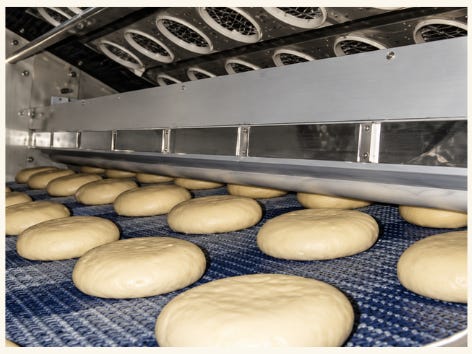
As water content increases toward 80% to 85%, excess free water saturates available hydrogen bonding sites on gliadins and glutenins.
Recommended Reading:

The dough’s ability to spring back and hold its shape (elastic modulus) tends to deteriorate faster than its internal resistance to flow (viscous modulus), progressively shifting from a soft elastic solid to a thick, slow-moving fluid. As hydration approaches 85% to 90%, yield stress drops toward minimal values, and the dough would struggle to sustain a vertical free boundary on open conveyor surfaces.
This progressive collapse creates two critical vulnerabilities:
Slumping and lateral flow: Without sufficient yield stress, the gravitational pressure at the base of a dough piece could exceed the dough’s resistance, causing it to spread horizontally, lose height, and overflow its support.
Alveolar rupture from mechanical stress: The gas cell walls in highly hydrated doughs may thin to near-invisible films, often thinner than a human hair. Any abrupt acceleration, vibration, or shear event during transport could rupture these thin films, triggering irreversible coalescence of small bubbles into large, uncontrolled gas pockets, or complete degassing at the base.
A third vulnerability compounds the first two:
Surface Skinning: When air velocity inside the proofer exceeds roughly 0.3 m/s, or humidity drops below 82%, evaporation at the dough surface outpace internal moisture diffusion. The resulting dried skin loses elasticity and crack unpredictably during oven spring, producing irregular tears and compromised volume.
Recommended Reading:

Proofing Technologies and Dough Handling Systems
The industrial response combines dedicated proofer designs with gentle upstream makeup systems.
Vertical continuous tray proofers with rigid peel-boards
Systems like AM Technology S.r.l. Nuvola and Royal Kaak Multi-Step Proofer operate as vertical continuous tray elevators (often called paternoster loops), circulating rigid carrier boards upward and downward without tilting. Dough pieces are deposited via retractable belt loaders, where the belt retracts at the same linear speed as the dough advances, achieving zero relative velocity. This would effectively eliminate interfacial shear during loading.

Key operational parameters in this range:
Hydration window: Frequently designed for doughs in the 75% to 85% range, where yield stress typically remains high enough for reliable free-standing fermentation on a flat board without lateral spreading.
Boards cycle through automatic brushing, vacuum aspiration, and re-dusting with hydrophobic rice flour or coarse semolina, which serves as a dry micro-bearing bed that could significantly reduce adhesion at peeling.
Air velocity is maintained at or below 0.3 m/s, with relative humidity held around 85% at 30°C. The continuous vertical elevator configuration maximizes volumetric use of plant height, minimizing the floor footprint.
Recommended Reading | In partnership with Rexfab Inc.
Discover how minimizing mechanical shock, abrupt decelerations, and transfer vibrations protects dough integrity and overall plant yield.

The practical upper boundary for open-board fermentation tends to sit near 85% hydration. Beyond this threshold, yield stress would typically drop to levels too low to prevent lateral spreading, and the dough could begin flowing outward unless high-strength flours (W above 360) and cold bulk pre-fermentation are used.
Continuous Spiral Proofers
Spiral proofing towers can transport product in two ways:
Directly on the belt surface
Inside trays and containers

For high-hydration doughs like ciabatta and focaccia, the second option would be mandatory. Soft, wet dough simply cannot hold its shape on an inclined helical belt without flowing sideways, sagging, or sticking to the mesh.
Once containment is resolved, the next challenge is vibration. Conventional friction-driven spirals use a central drum spinning slightly faster than the belt, which creates intermittent jerking (stick-slip motion) that could rupture the thin gas cell walls inside proofing dough.
Solutions from companies like TECNOPOOL address this by using drum-free systems that replace the central friction drum with direct peripheral drive, delivering smooth, constant-velocity transport with no mechanical resonance transmitted to the trays.
3. Zero-stress makeup lines
Soft doughs for ciabatta, focaccia, and pinsa in the 75% to 88% hydration range require gentle handling to preserve gas bubbles before final proofing. Companies like CANOL SRL and Royal Kaak develop dedicated low-shear makeup systems that replace aggressive dividing pistons and forced extrusion with passive, gravity-assisted processes.

The sequence typically follows this progression:
Bulk fermentation in mobile troughs: Extended rest at 18°C to 24°C after minimal mixing allows disulfide bond reorganization and enzymatic activity to build extensional strength naturally.
Controlled gravity discharge: Hydraulic tipping units tilt mobile troughs at an exceptionally slow, controlled pace, allowing the dough mass to slide gently onto lubricated transfer chutes without stretching or tearing.
Compression-free sheet forming: Instead of conventional high-pressure roller pairs, floating satellite multi-rollers and converging low-angle belts reduce dough thickness by gravity assistance alone, avoiding forced compression that could collapse internal gas cells.
Ultrasonic guillotine portioning: High-frequency vibrating titanium blades create an acoustic separation layer that virtually eliminates friction, cleanly sectioning delicate gluten strands without dragging or sealing cell edges.
Gentle depositing onto proofing carriers: Portion-cut pieces transfer smoothly onto peel-boards, trays, or conveyor belts with zero relative velocity, preserving their pre-fermented gas matrix.
In high-hydration production, the makeup philosophy shifts from forced mechanical shaping to gentle volume reduction. Every transfer point, roller interface, and cutting surface must operate below the dough’s critical shear threshold to prevent degassing before the final proof.
😊 Thanks for reading!
Sources
Royal Kaak, “Baking Freestanding Bread,” Baking & Biscuit International, 2023 (https://bakingbiscuit.com/bbi-royal-kaak-baking-freestanding-bread/)
AM Technology Srl, Exhibitor Profile & Nuvola High-Hydration System, IBA Trade Fair Düsseldorf, 2025 (https://www.iba-tradefair.com/en/discover/all-exhibitors-and-suppliers/am-technology-srl)
AM Technology Srl, Industrial High-Hydration Leavening Systems (https://www.am-technology.com/impianti-industriali/lievitazone-impasti-alta-idratazione/)
NewCap Bakery Systems (Verhoeven Family), Final Proofing & Step Proofer, 2026 (https://www.newcapbs.com/final-proofing/)
Tecnopool SpA (TP Food Group), Proofing Spiral Systems & T-Worth/TP-5 Conveyors, 2026 (https://www.tecnopool.it/en/solutions/proofing-spiral/)
Intralox L.L.C., Series 2900 Spiral DirectDrive System, 2026 (https://www.intralox.com/belt-finder/modular-plastic-belting/series-2900/spiral-directdrivetm-dd)
Canol Srl, Industrial Bread Lines & Zero Stress Sheeting, 2026 (https://www.canol.it/en/product/bread-line/)
Merand Mécapâte, Retractable Belt Conveyors & Automatic Depositing Systems, 2026 (https://www.merand.fr/en/products/conveyors-automatic-loading-systems/retractable-belt)
Bakerpedia, The Importance of Proofing & Industrial Humidity Control, 2026 (https://bakerpedia.com/the-importance-of-proofing/)